When getting around starts to feel like a chore — when the grocery store seems too far to walk, or a neighborhood stroll gets cut short because your knees won’t cooperate — a mobility scooter can quietly change everything. It’s not about giving up independence. It’s about getting it back.
We evaluated the best mobility scooters for seniors with one question in mind: which ones actually make daily life easier? That meant looking closely at how easy they are to transport in a regular car, how far they travel on a charge, how they handle real outdoor terrain, and whether the controls are simple enough to use without reading a manual twice.
Here’s what we found.
What Should You Look for in a Mobility Scooter for Seniors?
The most useful mobility scooter for a senior is the one that fits their actual life — not the one with the most features. Here are the factors that matter most.
Portability and disassembly: If you want to take the scooter to appointments, stores, or family gatherings, it needs to fit in a car. Travel scooters disassemble into pieces (typically 4–6) without tools, with the heaviest piece usually around 25–30 lbs. If lifting even that is difficult, look at models with car-lift accessories or consider a folding scooter that fits in a trunk in one piece.
Range per charge: For around-the-neighborhood use, 8–10 miles per charge is usually enough. For longer outings or full-day use at places like theme parks or large stores, look for 15+ miles. Always assume you’ll get about 20% less range than the manufacturer’s rated maximum, since real-world conditions (hills, heavier weight, older batteries) reduce output.
Weight capacity: Most standard mobility scooters are rated for 250–300 lbs. If the user weighs more than 250 lbs, look specifically for heavy-duty models rated for 400–500 lbs. Using a scooter beyond its weight rating accelerates wear on the motor and can compromise safety.
Turning radius: 3-wheel scooters offer a tighter turning radius — easier to navigate inside stores, hallways, and tight spaces. 4-wheel scooters are more stable on uneven outdoor terrain but require more space to turn. Most seniors find a 3-wheel travel scooter works well for mixed indoor/outdoor use.
Seat comfort: Seniors spend real time in these seats. Look for padded seats with armrests, adjustable height, and — for outdoor scooters — a swiveling seat that makes getting on and off easier.
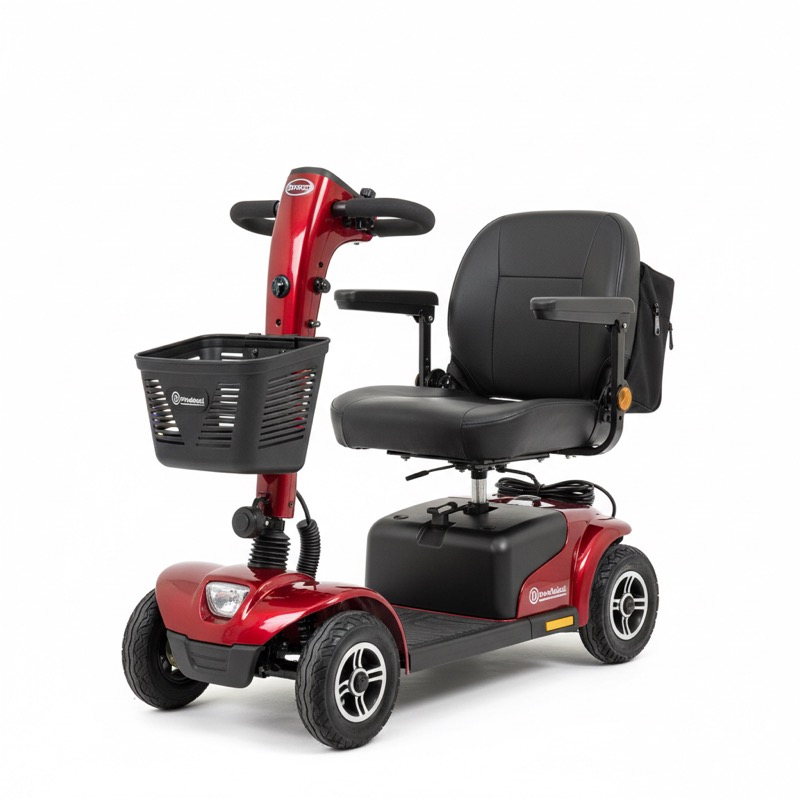
Drive Medical Scout Compact Travel Power Scooter
The Drive Medical Scout earns our top spot for the same reason it dominates this category: it solves the transportation problem better than nearly anything else at the price.
It breaks down into five pieces — front basket, tiller, seat, front body, and rear body — without any tools. The heaviest single piece is 27 lbs. That’s light enough for most adults to lift into a car trunk, and the process takes about 60 seconds once you’ve done it a few times.
The Scout handles everyday outdoor surfaces well — sidewalks, shopping center parking lots, light grass. The 9-mile range per charge covers most daily errands comfortably. The turning radius is tight enough for indoor grocery shopping without clipping shelves.
It’s not a high-speed scooter. Top speed is 4.25 mph, which is brisk walking pace — appropriate for sidewalks and stores, not for covering serious ground outdoors. If you need to travel distances over 2 miles on a single outing, look at the EWheels EW-36 below.
Weight capacity: 300 lbs Range: Up to 9 miles per charge Top speed: 4.25 mph Price range: $650–$900 Best for: Most seniors who want a scooter they can take anywhere in their car
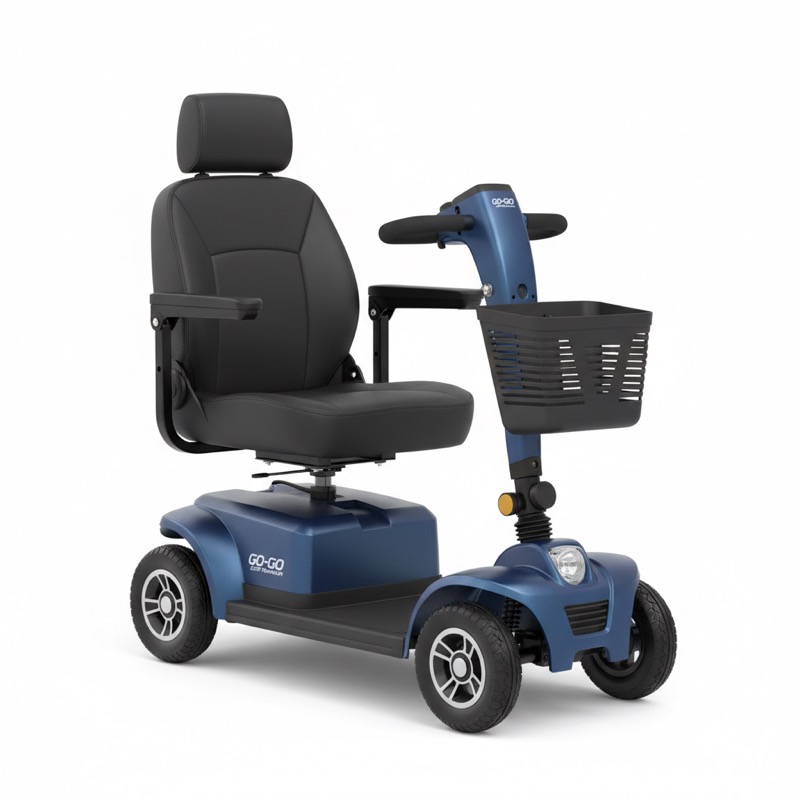
Pride Mobility Go-Go Elite Traveller
Pride Mobility is one of the longest-standing names in mobility equipment, and the Go-Go Elite Traveller earns its reputation. It’s available in both 3-wheel and 4-wheel configurations — an advantage for buyers who want to match the scooter to their primary use case.
The 3-wheel version turns tighter for indoor use. The 4-wheel version adds stability for outdoor terrain, particularly for users who feel uneasy about lateral stability on slopes or uneven ground. Both use Pride’s “Feather-Touch” disassembly — similar to the Drive Scout in that the heaviest piece is around 27 lbs.
The Comfort-Trac suspension on the front fork is a standout feature that the Scout doesn’t offer. On cracked sidewalks and rough parking lot surfaces, that suspension noticeably smooths out the ride. For seniors with back pain or joint sensitivity, it makes a real difference over a full outing.
The 8-mile range is comparable to the Scout. Where the Go-Go earns its slightly higher price is in the suspension, the 4-wheel option, and Pride’s generally excellent service network.
According to AARP’s mobility aid guidance, choosing a scooter from a brand with accessible dealer support is important for maintenance and repair — a key consideration for any senior-use mobility device.
Weight capacity: 300 lbs Range: Up to 8 miles per charge Top speed: 4 mph Price range: $750–$1,000 Best for: Users who want suspension comfort and the option for 3-wheel or 4-wheel stability
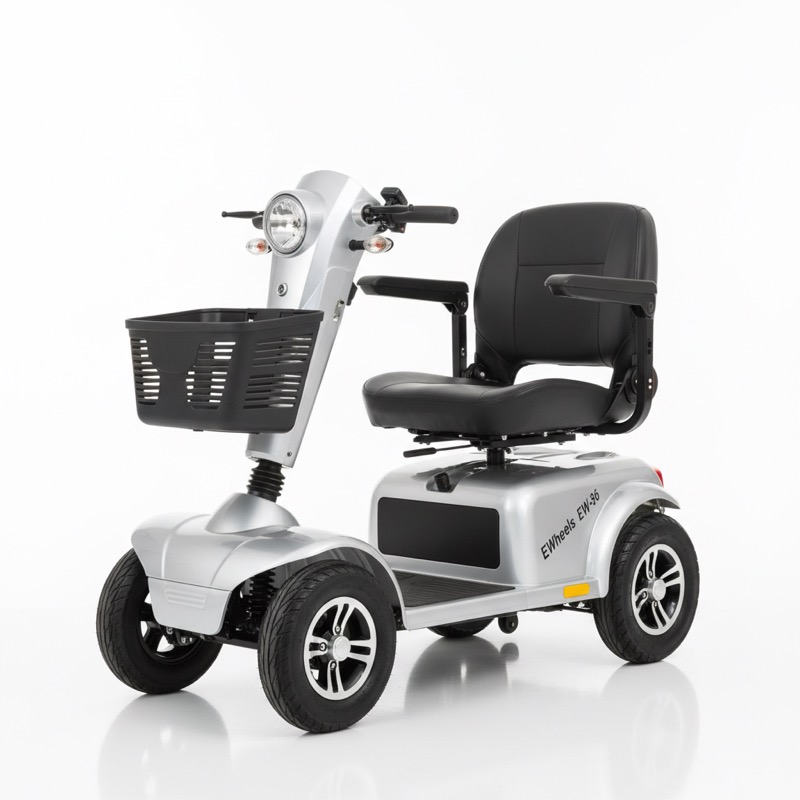
EWheels EW-36 3-Wheel Electric Scooter
The EWheels EW-36 is a different category of scooter entirely. While the Drive Scout and Pride Go-Go are designed for easy transport, the EW-36 is designed to go far.
Its 45-mile range per charge is the headline number — and it’s real-world capable, not just a lab figure. Top speed of 18 mph puts it squarely in street-legal territory in many states (check your local regulations). Full LED lighting — headlight, taillight, turn signals — makes it usable morning or evening. There’s even a built-in USB port for charging a phone.
This is not a scooter for loading into a car trunk. At over 100 lbs fully assembled, it needs a dedicated vehicle scooter lift or a garage ramp. What it’s designed for is daily transportation in a neighborhood, campus, or retirement community — replacing short car trips entirely rather than supplementing them.
The EW-36 is the right choice for a senior who lives somewhere they can ride directly to stores, friends’ homes, or medical appointments. It’s not the right choice for someone who needs to load it into a car for each outing.
Weight capacity: 400 lbs Range: Up to 45 miles per charge Top speed: 18 mph Price range: $1,400–$1,800 Best for: Seniors in pedestrian-friendly areas who want to replace short car trips with a long-range electric scooter
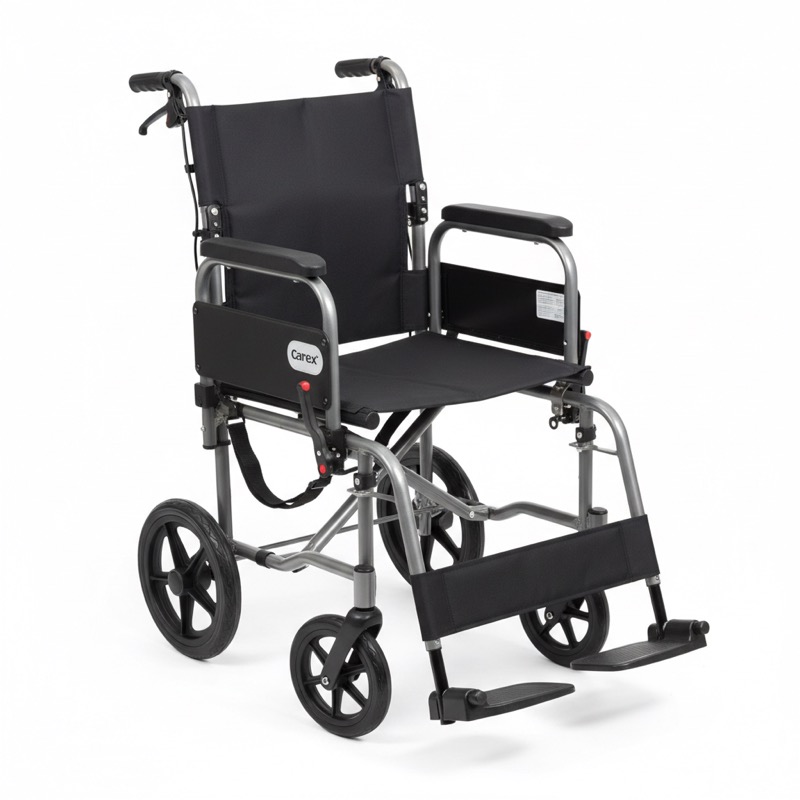
Carex Transport Chair — Best Companion Option
Not every senior needs a full motorized scooter for every situation. The Carex Transport Chair fills a different but complementary role: a lightweight folding chair pushed by a caregiver, ideal for indoor venues like airports, hospitals, large stores, or event spaces where a scooter isn’t practical.
Carex is an Awin-affiliated brand with one of the strongest reputations in US bathroom and mobility safety products. Their transport chairs fold down quickly, have padded seats and armrests, and include swing-away footrests for easy transfers. The heel loops keep feet secured on the footrests during movement.
For seniors who use a mobility scooter primarily outdoors but still rely on caregiver assistance indoors, having a transport chair alongside the scooter covers the full range of situations.
Weight capacity: 300 lbs Best for: Indoor venue use, caregiver-assisted transport, pairing with a motorized scooter for complete coverage
Merits Health S741 Heavy Duty Scooter
Are Mobility Scooters Covered by Medicare?
Medicare Part B may cover a mobility scooter when a doctor documents that you have a mobility limitation that significantly restricts your ability to participate in daily activities, and that a scooter is medically necessary. This falls under the “power-operated vehicle” (POV) category.
The process requires:
- A face-to-face examination with your doctor
- A written prescription documenting the medical necessity
- Purchasing through a Medicare-enrolled Durable Medical Equipment (DME) supplier
- Pre-authorization in many cases
Coverage typically pays 80% of the approved amount after the Part B deductible, leaving you responsible for 20%. The Medicare.gov coverage overview explains the criteria in detail — it’s worth reviewing before purchasing to understand what’s reimbursable.
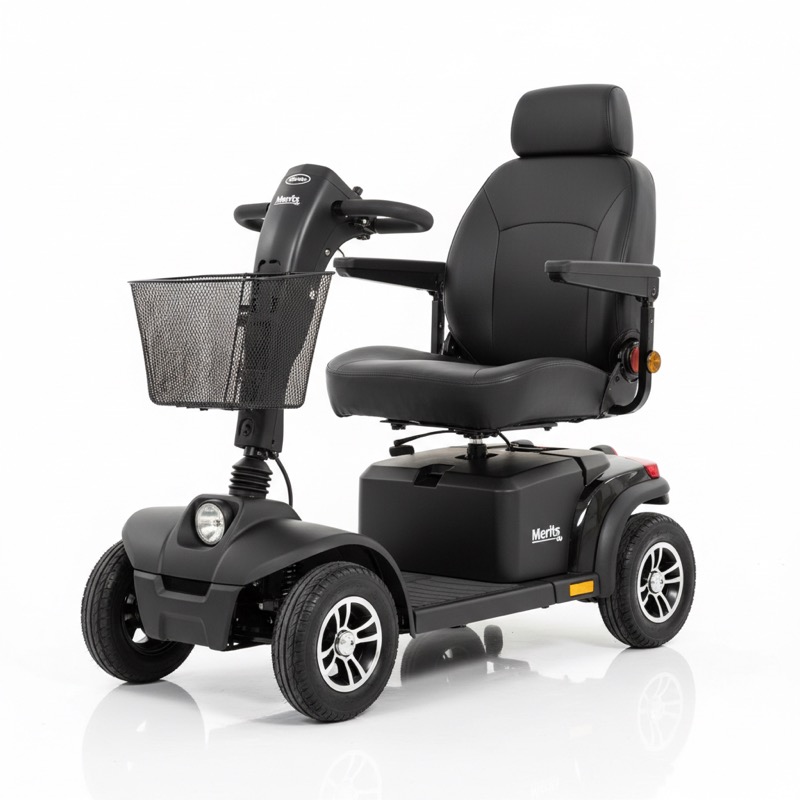
Merits Health S741 Heavy Duty Scooter
For seniors over 300 lbs, most travel scooters simply aren’t an option. The Merits Health S741 is purpose-built for heavier users who need reliable, safe power mobility.
The 500-lb weight capacity is the headline number. The 20-inch wide seat with padded armrests is genuinely comfortable at wider body dimensions — not just an afterthought. Flat-free tires eliminate the concern about tire maintenance. The 18-mile range handles a full day of use for most purposes.
The S741 is a heavier scooter at around 270 lbs fully assembled — it requires a vehicle lift to transport. For a senior who will use this primarily around their home, neighborhood, or retirement community, the transportation weight is less of a concern. What matters is that it handles the weight rating safely and comfortably, and it does.
Weight capacity: 500 lbs Range: Up to 18 miles per charge Top speed: 5 mph Price range: $2,200–$2,800 Best for: Seniors over 300 lbs who need a reliable heavy-duty mobility scooter with genuine bariatric capacity
Is a 3-Wheel or 4-Wheel Scooter Better for Seniors?
This is one of the most common questions when buying a mobility scooter. Here’s the practical answer:
3-wheel scooters have a single front wheel that allows a tighter turning radius. They’re easier to maneuver indoors — in store aisles, hallways, and elevators. The trade-off is slightly less lateral stability, particularly on uneven surfaces or when turning at higher speeds. For most indoor-to-outdoor use on typical sidewalks and parking lots, a 3-wheel scooter handles well.
4-wheel scooters have two front wheels and offer a wider, more stable base. They feel more solid on outdoor terrain — grass edges, gravel paths, slight slopes. The trade-off is a wider turning radius that can make maneuvering in tight indoor spaces awkward. If the primary use is outdoor walking paths, parks, and neighborhood streets rather than indoor venues, a 4-wheel design is worth considering.
For most seniors who split use between indoor errands and outdoor outings, we recommend starting with a 3-wheel travel scooter and seeing if the maneuverability meets your needs.
What Is the Best Mobility Scooter for Traveling by Air?
Airlines require mobility scooters to be checked as assistive devices — they’re transported in the cargo hold at no charge under the Air Carrier Access Act. The battery is the key concern: most lithium batteries under 300Wh are allowed if properly secured, but airlines vary in their specific requirements.
For frequent travelers, look for scooters specifically marketed as “airline-approved” that include documentation of battery specifications. Always notify your airline at booking that you’re traveling with a scooter, and arrive early enough to have it properly tagged and handled. The TSA provides detailed guidance on traveling with power wheelchairs and scooters that covers the security screening process.
How Long Do Mobility Scooter Batteries Last?
Most mobility scooter batteries last 1–2 years with regular use before noticeable range degradation. A battery that originally delivered 9 miles per charge may deliver only 6–7 miles after 18 months of daily use.
To extend battery life:
- Charge after each use rather than waiting for full depletion
- Store in a climate-controlled environment — extreme cold significantly reduces battery performance
- Don’t store on the charger indefinitely once fully charged; disconnect when the indicator shows full
- If the scooter will be unused for several weeks, charge to 50–60% before storage
Replacement batteries typically cost $80–$200 depending on the model. Most major brands — Drive Medical, Pride Mobility, EWheels — sell replacement batteries directly and through authorized dealers.
Frequently Asked Questions About Mobility Scooters for Seniors
How fast do mobility scooters for seniors go? Travel and compact scooters typically top out at 4–5 mph — brisk walking speed. This is intentional for safe indoor and sidewalk use. Long-range outdoor scooters like the EWheels EW-36 can reach 15–18 mph and are designed for road-adjacent use.
Do you need a license to ride a mobility scooter? In most US states, no license is required for mobility scooters. They’re classified as pedestrian devices when used on sidewalks. Higher-speed models (over 10 mph) may be subject to local road regulations — check your state’s rules before purchasing a high-speed model.
Can mobility scooters be used in rain? Most mobility scooters have basic weather resistance but are not designed for heavy rain. Light drizzle is generally fine; the electronics are sealed well enough for brief exposure. Sustained rain, deep puddles, and riding through standing water should be avoided. Always dry the scooter thoroughly before charging if it gets wet.
What is the weight limit on most mobility scooters? Standard travel scooters are typically rated for 250–300 lbs. Mid-range outdoor scooters cover 350–400 lbs. True bariatric/heavy-duty models like the Merits S741 reach 500 lbs. Always check the specific model’s rating and aim for at least a 50-lb buffer.
Can I use a mobility scooter inside stores? Yes. Most stores in the US are required under the ADA to accommodate mobility scooters as assistive devices. Larger retailers like Walmart, Target, and grocery chains often provide store-owned scooters as well. A personal 3-wheel travel scooter navigates most store aisles without difficulty.
The Right Scooter Changes Daily Life
Scooters are one option in a wider range of mobility equipment. Our senior mobility hub covers all categories — walkers, canes, rollators, lift chairs, and scooters — if you’re still comparing options.
A mobility scooter isn’t a last resort — it’s a tool that lets seniors stay active, connected, and independent long past the point where walking distances have become a barrier. The difference between staying home and getting out to a farmer’s market, a garden center, or a friend’s neighborhood is sometimes just the right piece of equipment.
For most seniors, the Drive Medical Scout is the place to start: portable enough to take anywhere, capable enough for everyday use, and priced honestly for what it delivers. For longer-range needs or heavier users, the EWheels EW-36 and Merits S741 each address specific situations the Scout doesn’t.
If mobility in general — not just scooters — is a concern, our best walkers for seniors guide and our best medical alert systems for seniors review cover the complementary equipment that makes staying active and safe easier.
Related: Best Walkers for Seniors | Medical Alert Systems for Seniors | Best Lift Chairs for Seniors