
Most rollators come with a seat. Not all rollators work outdoors. The question when shopping for an all-terrain walker with a seat isn’t just whether it has somewhere to sit — it’s whether the wheels can actually handle outdoor surfaces without catching, sinking, or tipping.
This guide focuses on all-terrain walkers that genuinely perform outdoors and include a reliable, comfortable seat for resting mid-walk. We looked at wheel size, seat padding and weight rating, brake ergonomics, and how each model folds for transport.
Why the Seat Matters as Much as the Wheels
Outdoor walking is more tiring than indoor movement. Uneven surfaces, slight grades, and longer distances all add up — and for elderly users, fatigue increases fall risk. A built-in seat changes the math entirely. If you know you can stop and rest anywhere — on the trail, at the park, between storefronts — you’ll walk farther and push yourself less hard.
The seat quality varies significantly between rollators:
- Seat width: Aim for at least 18 inches. Narrower seats feel unstable and aren’t comfortable for extended sitting.
- Padding: Padded seats are noticeably more comfortable for sitting longer than 30 seconds. Unpadded plastic seats work in a pinch but aren’t suitable for resting on longer walks.
- Weight rating: Most standard rollator seats are rated for 250–300 lbs. Heavy-duty models go to 400 lbs or more. Always verify the seat weight rating, not just the frame rating — some rollators list the frame capacity but a lower seat capacity in the fine print.
- Seat height: Fixed vs. adjustable. Fixed seats are fine if the height happens to match you. Adjustable seats (on some higher-end models) let you dial in a comfortable sit-to-stand height.
Top 5 All-Terrain Walkers with Seats
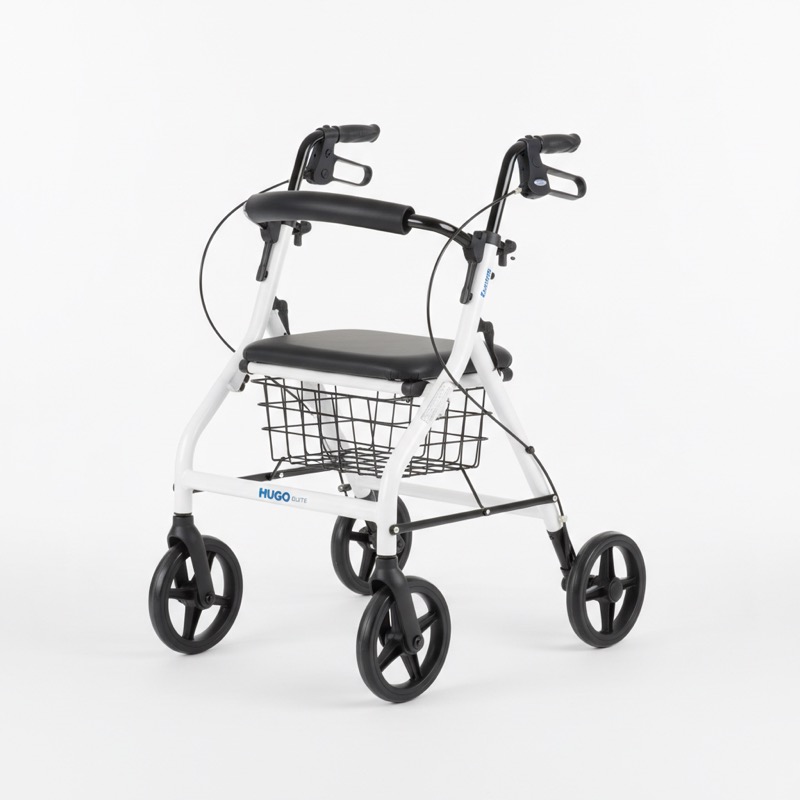
1. Hugo Mobility Elite Rollator — Best Overall
The Hugo Mobility Elite combines genuine outdoor wheel performance with one of the better standard seats in its class. The 8-inch wheels handle most outdoor surfaces without catching — gravel, grass, packed dirt, cracked pavement. The padded seat is rated for 300 lbs and is firm enough to sit on comfortably rather than just perching for a moment.
The loop brakes are easy to squeeze even for users with arthritis or reduced grip strength, and they lock securely when you press them down before sitting — a critical safety feature that some users skip. Frame folds flat in under 10 seconds.
One note: the Hugo is about 26 inches wide when open. If you’re also using it indoors, measure your entry doorframe — standard interior doors run 24–28 inches wide.
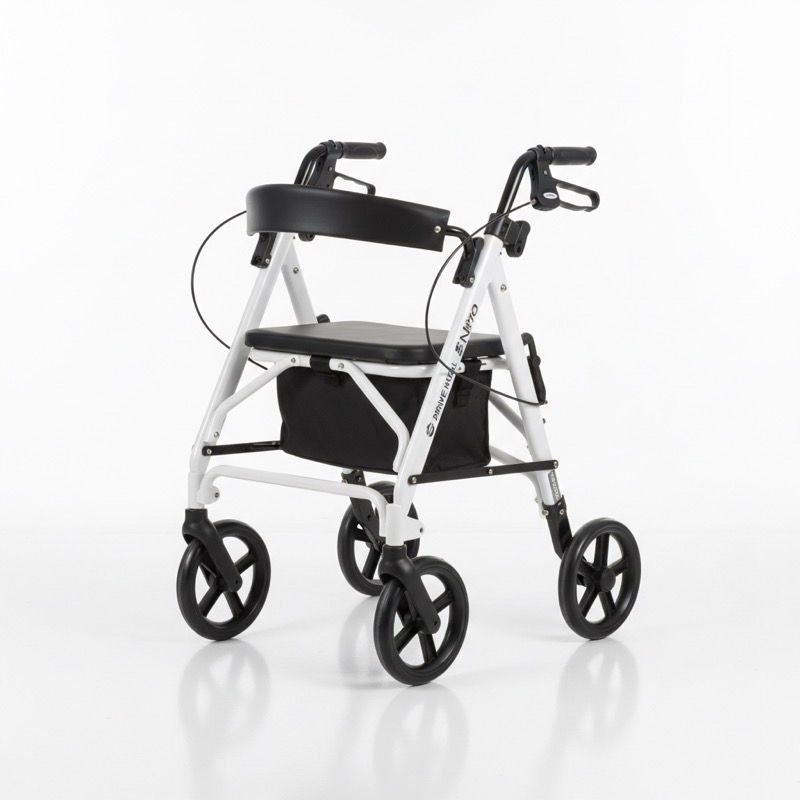
2. Drive Medical Nitro — Best for Rough Terrain
If you walk on genuinely rough outdoor surfaces — loose gravel, soft grass, roots, or dirt paths — the Drive Medical Nitro is in a class of its own. The 10-inch wheels are the largest available on any consumer rollator. They genuinely roll over small obstacles that would stop or catch smaller-wheeled models.
The underseat storage bag is included (most competitors charge extra). The seat is padded and well-supported. At 17 lbs with a narrow fold profile, it fits in most car trunks standing upright.
The trade-off is price — the Nitro costs more than comparable outdoor rollators. For seniors who walk outside daily on variable terrain, that cost is justified. For occasional outdoor use on smooth paths, the Hugo above may be sufficient.
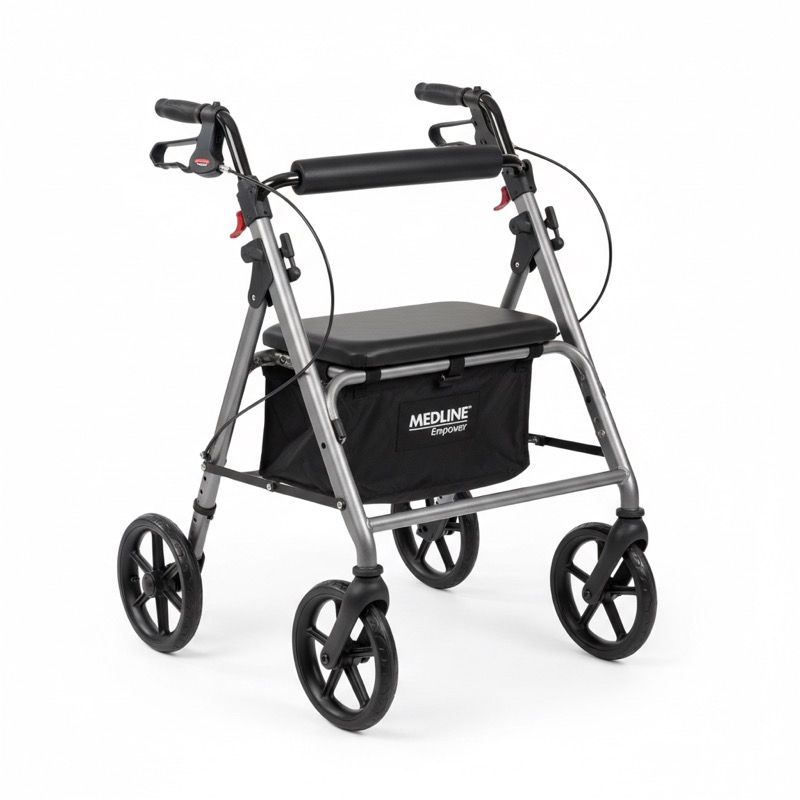
3. Medline Premium Empower — Best Budget Option
The Medline Premium Empower brings hospital-grade construction and a padded seat to a price point accessible on a fixed income. The 7.5-inch wheels handle smooth pavement and packed paths confidently. Loose gravel is manageable, though not as smooth as the larger-wheeled options above.
The seat is padded and the rubberized handle grips make longer walks more comfortable. The one limitation: fixed seat height. If the height doesn’t match your proportions, you can’t adjust it. For most seniors in the 5’3”–5’10” range, the fixed height works fine.
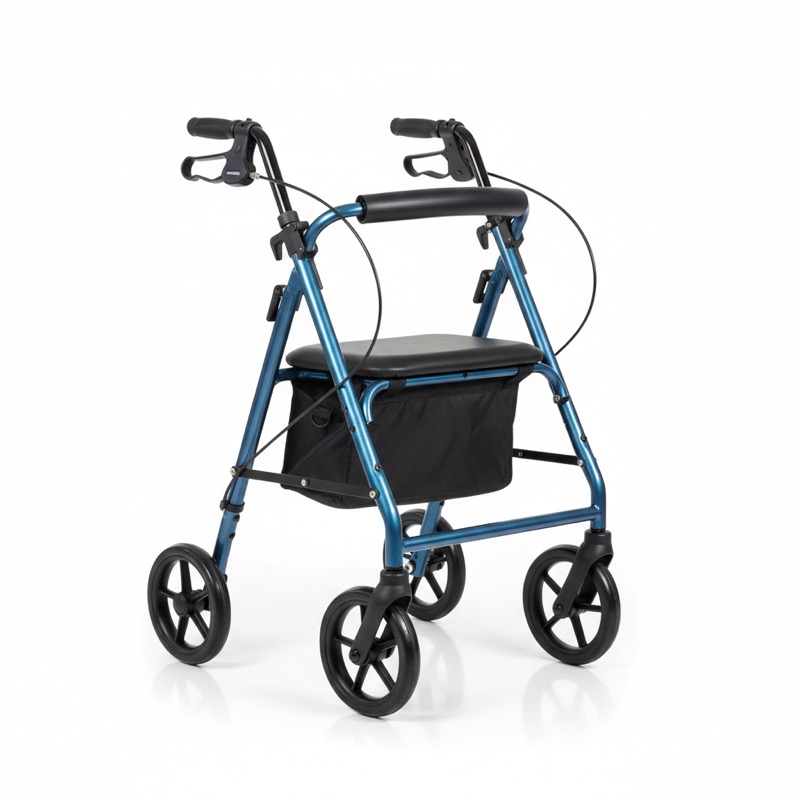
4. OasisSpace Compact Rollator — Best for Travel
The OasisSpace Compact Rollator is the choice when you need something that fits in a small car, airplane overhead storage, or hotel room closet. At under 15 lbs with a compact fold, it’s among the most portable aluminum rollators with a seat.
The 7.5-inch wheels work on sidewalks, park paths, and smooth outdoor surfaces. On rougher terrain — gravel or soft ground — you’ll feel the limitation compared to 8- and 10-inch wheel models. But for travel, the portability wins.
5. Carex Trio Rolling Walker — Best All-Around Value
The Carex Trio Rolling Walker is worth considering for seniors who want a straightforward outdoor walker with a seat at a competitive price from a brand that specializes in senior mobility products. The padded seat, aluminum frame, and loop brakes cover the basics well. Carex focuses exclusively on mobility and daily living aids for seniors, which shows in the build quality and ergonomics.
How to Use the Seat Safely
The seat on a rollator is only as safe as the brake lock. Every time before sitting:
- Come to a complete stop.
- Squeeze both brake levers and press down to engage the lock.
- Test the lock by giving the walker a slight push. It should not move.
- Sit down and shift your weight centered over the seat.
- To stand, push up from the seat handles (not the frame) while releasing the lock.
Sitting on an unlocked rollator is the most common cause of rollator-related falls. Make locking the brakes a habit before every sit.
Weight Capacity: Why It Matters More Than You Think
Standard rollator seats are typically rated 250–300 lbs. If you’re near or above that range, don’t assume a standard model will hold — the rating is usually a conservative maximum, but frames and seats can flex or weaken over time under sustained higher loads.
For seniors over 280 lbs, look specifically for models rated 350–400 lbs. Heavy-duty rollators exist in this range, typically with reinforced frames and wider seats. They weigh more and cost more, but the structural integrity is designed for the load.
Our mobility hub for seniors has a full overview of walker types, rollators, canes, and mobility scooters with honest comparisons. For a complete breakdown of all-terrain performance, see our main guide to best all-terrain walkers for seniors — which covers the full outdoor rollator category, including terrain testing notes and fit recommendations.
Frequently Asked Questions
Do all rollators come with a seat? Most rollators (four-wheeled rolling walkers) include a seat. Three-wheeled rollators sometimes don’t. Standard two-wheeled or four-legged walkers (non-rolling) never include a seat. If having a seat is important, confirm it explicitly before purchasing — and check the weight rating.
How do I know if the seat weight rating is enough for me? Check both the frame capacity and the seat capacity. Some rollators list a 350 lb frame rating but a 300 lb seat rating. If the listing doesn’t specify a separate seat rating, contact the manufacturer or look for an explicit seat rating in the product manual. When in doubt, choose a model rated 50 lbs above your actual weight.
Can I use an all-terrain rollator with seat as my main indoor walker? Yes, with one caveat: all-terrain rollators are typically wider than standard indoor models (24–28 inches vs. 22–24 inches open). Measure narrow doorways before committing to an outdoor rollator as your primary walker. Many users keep one rollator for indoors and one for outdoors, though the Hugo Mobility Elite and OasisSpace both manage the transition reasonably well.
How high should the seat be on an outdoor rollator? The seat height should let you sit with feet flat on the ground and knees at approximately 90 degrees. For most seniors, a seat height of 19–22 inches works. If you can, test the seat height before purchasing — or measure the seat height in the product specifications and compare it to your chair height at home.