
Here’s a number worth sitting with: 80% of falls among older adults happen in the bathroom.
That’s from the CDC. Not a general fall estimate — specifically bathroom falls. The wet floors, the awkward step over the tub, the moment of getting up from the toilet when your legs haven’t fully woken up yet. The bathroom is designed for standing still and staying clean. It is not designed for people whose balance, strength, or reaction time isn’t what it used to be.
The good news is that most of those falls are preventable. Not with a major renovation. Not with moving out. With a grab bar in the right spot, a non-slip mat, and maybe a shower chair — the bathroom becomes significantly safer without looking like a hospital room.
This guide walks you through the six products that make the biggest difference, starting with the ones that matter most.
The Most Dangerous Room in the House
The numbers from the CDC are stark. Each year, roughly 235,000 people over 15 visit emergency rooms for injuries suffered in the bathroom. For adults 65 and older, bathroom falls are one of the leading causes of hip fractures — and a hip fracture is one of the most serious injuries an older adult can have. AARP research shows that one in five people who experience a hip fracture don’t recover to their prior level of independence.
What makes the bathroom so dangerous?
Hard floors get wet. Ceramic and porcelain tile are slippery when dry. Add water — from a shower splash, a wet towel on the floor, or condensation — and they become genuinely hazardous.
Awkward movements are unavoidable. Getting in and out of a tub requires stepping over a 12–18 inch barrier on one leg. Standing up from the toilet uses the same muscles that weaken first with age. These aren’t theoretical dangers — they’re daily events.
Nothing to hold onto. Most bathrooms were designed before accessibility was a design priority. Towel bars are not structural. The toilet paper holder is not structural. In most bathrooms, there is simply nothing to grab if you start to lose your balance.
That’s what bathroom safety products address — one hazard at a time.
The 6 Products That Make the Biggest Difference
Carex Tub Grab Bar — Best Grab Bar
The step over the tub edge is one of the highest-risk moments in any bathroom. You’re on one leg, shifting weight, often slightly off-balance — and there’s nothing to hold onto.
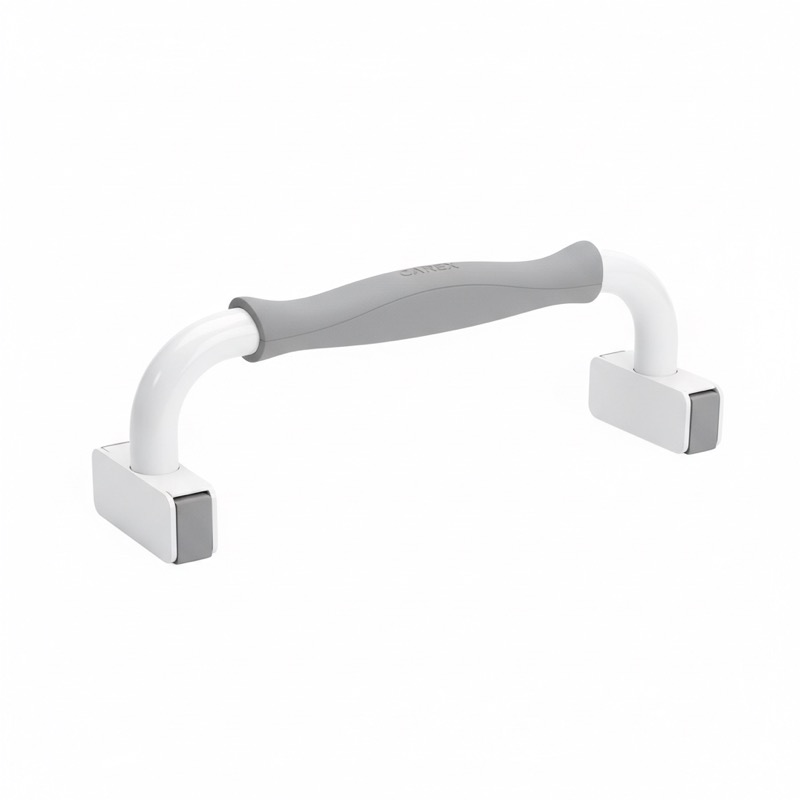
A grab bar fixes that. The Carex Tub Grab Bar clamps to the rim of a standard bathtub without drilling, without a contractor, and without tile damage. It installs in a few minutes and supports up to 250 lbs.
Carex has been making bathroom safety products for decades. This isn’t a cheap general-purpose bar — it’s engineered specifically for tub transitions, with an ADA-compliant grip diameter and a surface texture that stays secure even with wet hands.
For anyone getting in and out of a bathtub, this is the first product to buy.
Drive Medical Deluxe Shower Chair — Best Shower Chair
Standing for the full length of a shower takes more out of most seniors than they expect — especially if balance or stamina is an issue. A shower chair solves this without requiring any changes to the shower itself.
The Drive Medical Deluxe has a back support (many cheaper models don’t), adjustable height legs, and rubber feet that grip the shower floor. It holds up to 300 lbs and goes together without tools.
Sitting down to shower also reduces the risk of falls — you can’t fall over if you’re already seated. Physical therapists recommend shower chairs as a first-line safety measure, and for good reason.
Tike Smart Non-Slip Bath Mat — Best Non-Slip Mat
A wet bathroom floor is a wet bathroom floor. No amount of careful stepping fully compensates for a slippery surface.
A quality non-slip mat changes the floor’s behavior. The Tike Smart uses over 200 suction cups that press against the floor and hold — unlike cheap mats that curl up at the edges and peel away when they get wet.
It’s machine washable, which matters because a mat that collects mold and mildew is creating a different kind of problem. The antimicrobial material slows down that growth between washes.
This is one of the lowest-cost, highest-impact changes you can make in any bathroom.
Vaunn Medical Toilet Safety Rail — Best Toilet Rail
Getting up from a toilet is harder than most people realize until it becomes a problem. You’re pushing up from a low seat, often when your legs are stiff, with nothing stable to push against.
A toilet safety rail gives you something to push and pull on. The Vaunn clamps to the toilet itself — no hardware installation — and adds padded armrests on both sides. The frame supports 300 lbs.
For anyone with knee pain, hip problems, or post-surgery restrictions, a toilet rail often makes the difference between being able to use the bathroom independently and needing help every time.
Bath Step Stool — Best Tub Step
Not everyone needs a full transfer bench. Sometimes the issue isn’t stepping over the tub edge so much as stepping down onto a wet floor from an elevated tub rim.
A low-profile bath step creates an intermediate level — a place to put your foot before you’re all the way in or all the way out. It makes the tub edge feel like two small steps instead of one large one.
The extra-wide platform and non-slip surface matter here. A step stool that wobbles or slides defeats its own purpose.
Medical King Transfer Bench — Best for Limited Mobility
For seniors who can’t safely step over the tub rim at all, a transfer bench is the solution. It straddles the tub — two legs inside, two outside — and you sit on the outside portion, slide across, and lower yourself without stepping over anything.
It’s a bigger piece of equipment, and it changes the look of the bathroom more than a grab bar does. But for people with significant balance problems, lower-body weakness, or recovering from major surgery, it’s what makes bathing independently possible at all.
Physical therapists often recommend this as part of a post-hospitalization home safety plan.
How to Prioritize: Start Here
You don’t have to do everything at once. Here’s the order that makes the most sense based on where the greatest risk actually is:
1. Get a grab bar first. The tub transition is the single highest-risk moment in the bathroom. A grab bar addresses it immediately.
2. Add a non-slip mat. Cheap, effective, no installation required. Every bathroom should have one.
3. Consider a shower chair. If standing in the shower is tiring or if balance is uncertain, this is the next most important change.
4. Add a toilet rail if needed. If getting up from the toilet is difficult, this makes it safe again.
5. Look at a transfer bench or step only if the grab bar isn’t enough. Most people don’t need this, but if they do, it’s an important option.
A Word About Installation
Grab bars that clamp to the tub rim (like the Carex) require no drilling and no contractor. If you want a wall-mounted permanent grab bar, that’s a more involved project — it needs to go into wall studs or use specialty anchors rated for the load. A bar mounted into drywall without proper backing will pull out under load, and a bar that pulls out during a fall is worse than no bar at all.
For permanent installations, AARP and NIH both recommend hiring a certified aging-in-place specialist (CAPS) or a licensed handyman who understands the weight requirements. The investment is worth it. If you prefer DIY, our grab bar installation guide covers tile, drywall, and toggle-bolt methods with ADA mounting heights.
For the clamp-on options in this guide, installation is genuinely simple — most take under 10 minutes.
Bottom Line
Browse all reviewed bathroom safety products and buying guides in our senior bathroom safety resources — a single starting point for every category covered here.
The bathroom is the room in the house that most needs attention, and it’s often the last one to get it. A fall in the bathroom can set off a chain of events — injury, hospitalization, recovery, loss of independence — that no one wants to think about.
These six products break that chain before it starts. The Carex Tub Grab Bar is where most people should start. Add a shower chair and a non-slip mat, and the three biggest risks are addressed.
You don’t have to change everything at once. But changing something matters. The time to make the bathroom safer is before someone gets hurt in it.
Want more senior gear tips? Join our free newsletter — one email a week with product reviews, home safety ideas, and practical gear for independent living. No spam, ever. Subscribe here.