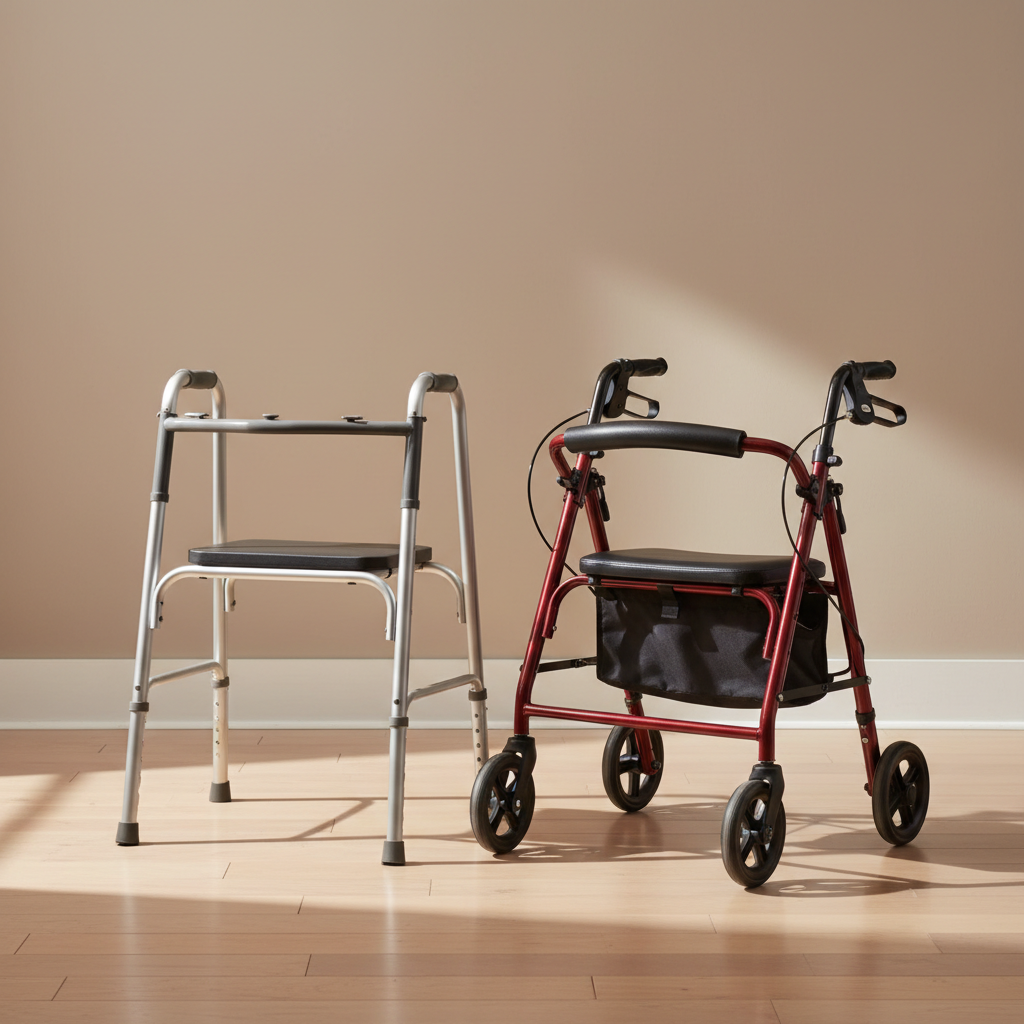
It’s one of the most common questions we hear from adult children helping a parent shop for mobility aids: should they get a rollator or a standard walker? Both are walkers in the everyday sense of the word, but they work differently, suit different needs, and can genuinely affect safety outcomes if you pick the wrong one.
This guide cuts through the confusion. Here’s what actually distinguishes these two types of walkers, when each is appropriate, and what your doctor or physical therapist is likely to tell you.
What Is a Standard Walker?
A standard walker — sometimes called a pickup walker — has four legs and no wheels. You lift it forward, set it down, and step into it. Some versions have two small wheels on the front legs to reduce the lifting effort while keeping the rear legs as stationary anchors.
Standard walkers are stable by design. Because they don’t roll freely, they’re less likely to slide away from you if you lean on them heavily. That makes them the preferred choice for people recovering from surgery, those with significant balance deficits, or anyone whose doctor has specified full weight-bearing support through the arms.
The downside is the motion itself. Lifting and planting a walker with every step is slow, tiring, and disruptive to a natural gait. Over time, this can actually reinforce poor walking patterns.
What Is a Rollator?
A rollator has four wheels, handbrakes, and typically a fold-down seat. You push it forward rather than lifting it, which produces a walking motion much closer to a natural stride.
The wheels do mean that a rollator can roll away from you if you lean on it without engaging the brakes. This is why rollators are generally not recommended for people who rely heavily on their walker for balance — the device needs to support your weight as a stationary object, not a moving one.
Rollators are better for people with good balance who need stability and endurance support: someone who can walk but fatigues quickly, or someone who needs a place to sit on longer outings.
The Core Trade-Off: Stability vs. Mobility
This is the heart of the rollator vs. standard walker debate.
Standard walkers win on stability. There’s almost no scenario where a four-legged, no-wheel walker rolls out from under you. For post-surgical recovery, neurological conditions like Parkinson’s that affect balance, or significant muscle weakness, that stability is clinically important.
Rollators win on mobility and ease of use. They’re faster, they encourage a more natural gait, they fold for transport, and the built-in seat makes them practical for longer outings. Occupational therapists often transition patients from a standard walker to a rollator once they’ve regained sufficient strength and balance.
When to Choose a Standard Walker
- You are recovering from hip replacement, knee replacement, or major lower-body surgery
- Your doctor or physical therapist has specified “weight-bearing as tolerated” through the walker
- You have a neurological condition affecting balance (Parkinson’s, stroke recovery, severe neuropathy)
- You tend to lean heavily on your walker rather than using it as a light support
- You primarily walk indoors on smooth, flat surfaces
When to Choose a Rollator
- You have good baseline balance but tire easily on longer walks
- You want to walk outside on sidewalks, paths, or in stores
- You need a place to sit and rest but don’t want to bring a separate chair
- You are managing mild to moderate balance issues but can safely control a wheeled device
- Your physical therapist has cleared you for a rollator after evaluating your gait
What Physical Therapists Actually Recommend
Physical therapists evaluate several factors before recommending one type over the other: the underlying diagnosis, gait pattern, upper body strength, cognitive ability to manage brakes, and whether the person needs to bear weight through their arms.
One common clinical observation: seniors often arrive using a standard walker out of habit or because it’s what was prescribed years ago, when they actually have the balance and strength to use a rollator more safely. A rollator’s more natural gait pattern reduces fatigue and often improves confidence outdoors. An annual re-evaluation by a PT is worth doing if you haven’t had one in a few years.
The reverse is also true. Some seniors are given rollators when they should have a standard walker — and fall because the rollator moved when they needed it to stay put.
Comparing Key Features Side by Side
| Feature | Standard Walker | Rollator |
|---|---|---|
| Wheel configuration | 0 or 2 front wheels | 4 wheels |
| Best for | High support needs | Mobility and endurance |
| Folds for transport | Most models, yes | Yes |
| Built-in seat | No | Yes (most models) |
| Brake system | None | Loop or push brakes |
| Outdoor use | Limited | Good (large wheels) |
| Natural gait | Disrupted | Supported |
| Weight | 5–9 lbs | 13–20 lbs |
Top Picks in Each Category
Standard Walker: Drive Medical Folding Walker with Wheels Drive Medical’s two-wheeled standard walker is one of the most recommended models in post-acute care. It’s lightweight (under 7 lbs), adjusts for users from 5 to 6’4”, and folds flat. The two front wheels reduce lifting effort while the rear legs stay grounded. It’s a practical, no-frills tool that does its job reliably.
Rollator: Hugo Mobility Elite Rollator Covered in our outdoor walkers guide as well, the Hugo Elite is a standout for everyday use. Large wheels, strong brakes, a well-padded seat, and an accessible price point. Physical therapists cite it frequently as an appropriate step-up from a standard walker for patients who have recovered sufficient balance.
Budget Rollator: Medline Premium Empower Rollator A solid hospital-grade option at a lower price. Not as refined as the Hugo or Drive Medical Nitro, but dependable and widely available through medical supply stores that accept Medicare assignments.
Frequently Asked Questions
Can I switch from a standard walker to a rollator on my own, or do I need a prescription? You don’t need a prescription to purchase either type. However, if you’re switching due to a medical condition or recent surgery, check with your physical therapist or physician first. Using the wrong type for your condition can increase fall risk. If you want Medicare to help cover the cost, you will need a prescription and a Medicare-enrolled supplier.
My parent keeps leaning on their rollator and it rolls away — is this dangerous? Yes, this is a real fall risk. A rollator is not designed to bear full body weight while rolling. If your parent consistently leans heavily on a rollator for support, they may need a standard walker instead. Talk to their physical therapist about a reassessment.
Is there a hybrid option? Some newer walker designs offer locking mechanisms that convert a rollator into a stationary frame. Models like the Hugo Adjustable Height Rollator have brake locks that hold the frame in place for standing-up transitions. These can work well for users who need a rollator for walking but a stable frame for sitting down and standing up.