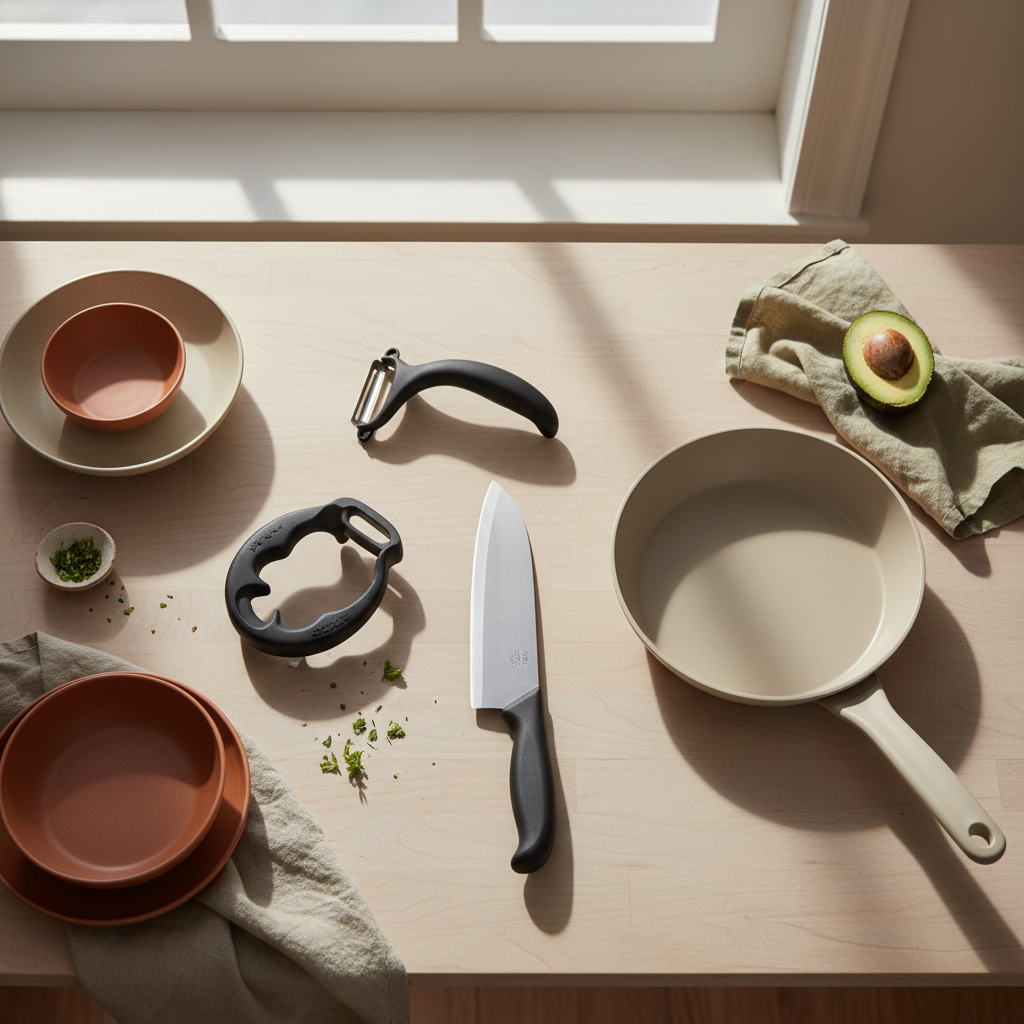
Cooking is one of life’s real pleasures — but when arthritis makes your hands ache, even simple tasks like opening a jar or peeling a potato can feel like a battle. The good news: the right tools make an enormous difference. You don’t need to give up cooking. You just need gear that works with your hands, not against them.
This guide covers the kitchen tools that consistently get high marks from seniors and occupational therapists alike. We focus on ease of grip, reduced joint strain, and tools that actually last.
What to Look For in Arthritis-Friendly Kitchen Tools
Before getting into specific products, it helps to know what separates a good arthritis-friendly tool from a regular one. You’re looking for a few key things.
Grip size and texture matter most. Thicker handles (roughly the diameter of a golf ball) distribute pressure across the palm rather than concentrating it on the fingers. Soft, non-slip rubber or silicone coatings let you hold securely without squeezing hard.
Leverage over force. Tools that use lever mechanics — jar openers, ergonomic can openers, loop scissors — let you apply minimal effort to get maximum results. This is the single biggest quality-of-life improvement for anyone with hand pain.
Lightweight construction. A heavy cast-iron pan may be a joy to cook in, but it’s hard on stiff wrists. Look for pans in the 2–3 lb range, and tools made from lightweight materials without sacrificing durability.
Jar and Can Openers: Stop Fighting Lids
A stuck jar lid is the number one kitchen frustration for seniors with arthritis. Two products stand out here.
The OXO Good Grips Jar Opener (our top pick) uses a one-motion lever that grips the lid and breaks the vacuum seal instantly. No twisting, no palm strain. It’s been a staple recommendation from occupational therapists for years, and for good reason — it works the first time, every time.
For cans, the OXO Good Grips Smooth Edge Can Opener is worth every penny. It cuts along the side of the lid rather than the top, so there are no sharp edges to worry about. The wide, cushioned handles are easy to squeeze, and the turning knob requires minimal wrist rotation.
If you open a lot of cans, consider an electric can opener instead. The Hamilton Beach Smooth Touch Electric Can Opener is a solid pick — just press one button and it does all the work. No grip strength required.
Cutting and Peeling: The Tasks That Strain Fingers Most
Chopping and peeling put steady pressure on the finger joints. A few simple upgrades help a lot.
Ergonomic peelers like the OXO Good Grips Swivel Peeler have a wide, cushioned handle that’s far easier to hold than a thin metal peeler. The blade pivots to follow the curve of vegetables, so you’re not fighting the angle.
For cutting, look at knives with a pistol-grip or D-handle design. These let you use your whole hand — more like a fist grip — rather than pinching the blade between thumb and forefinger. The Rachael Ray Cucina knife series offers budget-friendly options with comfortable handles, though for serious arthritis, ergonomic knives with angled handles (available from medical supply brands) work even better.
A rocker knife (also called a ulu knife) is worth trying if standard chef’s knives are painful. You rock the blade back and forth rather than chopping, using arm weight instead of wrist and finger effort.
Pots, Pans, and Heavy Lifting
Heavy cookware is a real hazard — not just uncomfortable, but potentially dangerous if your grip gives out. The shift toward lighter materials has been good news for seniors.
Rachael Ray’s nonstick hard-anodized cookware is a practical choice. The pans are lightweight (around 2–3 lbs for a 10-inch skillet), the nonstick surface means less scrubbing, and the handles stay cool on the stovetop. Nonstick also means you use less oil, which makes cleanup easier.
For boiling water, a lightweight kettle with two handles is safer than a standard heavy pot. Filling a kettle to a lower level (only as much water as you need) and using a kettle tipper cradle for pouring are both occupational therapy tricks that reduce wrist strain significantly.
The Progressive International Kitchenware line also offers lightweight mixing bowls with rubberized bottoms — they stay put while you stir, so you’re not fighting to hold the bowl still.
Small Appliances That Do the Hard Work
If gripping, squeezing, and repetitive motions are consistently painful, small appliances can step in for some of the toughest tasks.
A stand mixer like the KitchenAid Classic takes all the effort out of mixing and kneading. It’s an investment, but for anyone who bakes regularly, it pays for itself in reduced hand pain.
For chopping onions, nuts, or herbs, a Cuisinart Mini Food Chopper handles the knife work with a single press of a large button. It’s compact, easy to clean, and much safer than chopping freehand when your grip is unreliable.
An electric jar opener — different from the lever-style manual version — is another worthwhile gadget. Models like the Hamilton Beach Open Ease Automatic Jar Opener simply sit on the lid and spin it off automatically.
Timers and Measuring: Don’t Overlook the Details
One often-overlooked issue: small-print timers and measuring cups are genuinely difficult with aging eyes and stiff fingers. The OXO Good Grips Angled Measuring Cup has large print visible from above (no crouching to read the side), and the ThermoPro Digital Kitchen Timer has big tactile buttons that are easy to press and a display readable across the kitchen.
Frequently Asked Questions
What kitchen tools do occupational therapists recommend most for arthritis? Jar openers with lever mechanisms, ergonomic-handled peelers and knives, and lightweight nonstick pans come up consistently. The common thread is reducing the grip force and repetitive motion required for everyday tasks.
Are electric appliances worth it for seniors with arthritis? For many people, yes. Stand mixers, electric can openers, and electric jar openers replace tasks that require repeated gripping or twisting. The upfront cost is usually justified by the reduction in pain and the added safety margin.
What handle thickness is best for arthritic hands? Occupational therapists generally recommend handles between 1.25 and 1.5 inches in diameter — wide enough to distribute pressure across the palm without requiring a tight pinch grip. Soft, non-slip materials are more important than any single measurement.