Keeping tabs on your blood pressure at home is one of the smartest things you can do for your long-term health. Doctors call it “home blood pressure monitoring,” and study after study shows it gives a more accurate picture of your real numbers than a single office visit — no white-coat nerves, no rushing through a parking lot first.
The problem is that most monitors on store shelves were designed with 40-year-olds in mind. Tiny buttons. Small print. Cuffs that don’t fit larger arms. This guide cuts through the noise and focuses on monitors that work well for adults 65 and older.
What Makes a Blood Pressure Monitor “Senior-Friendly”?
Not all monitors are created equal. When we evaluated options for this guide, we focused on four things:
Clinical validation. The American Heart Association (AHA) recommends only upper arm monitors that have been independently validated for accuracy. Wrist monitors can be convenient, but they’re more sensitive to wrist position and tend to give inconsistent readings in older adults with stiffer arteries.
Ease of use. One-button operation, large buttons with clear labels, and an automatic cuff that inflates and deflates on its own are non-negotiable for many seniors. Manual monitors that require a stethoscope are best left to clinicians.
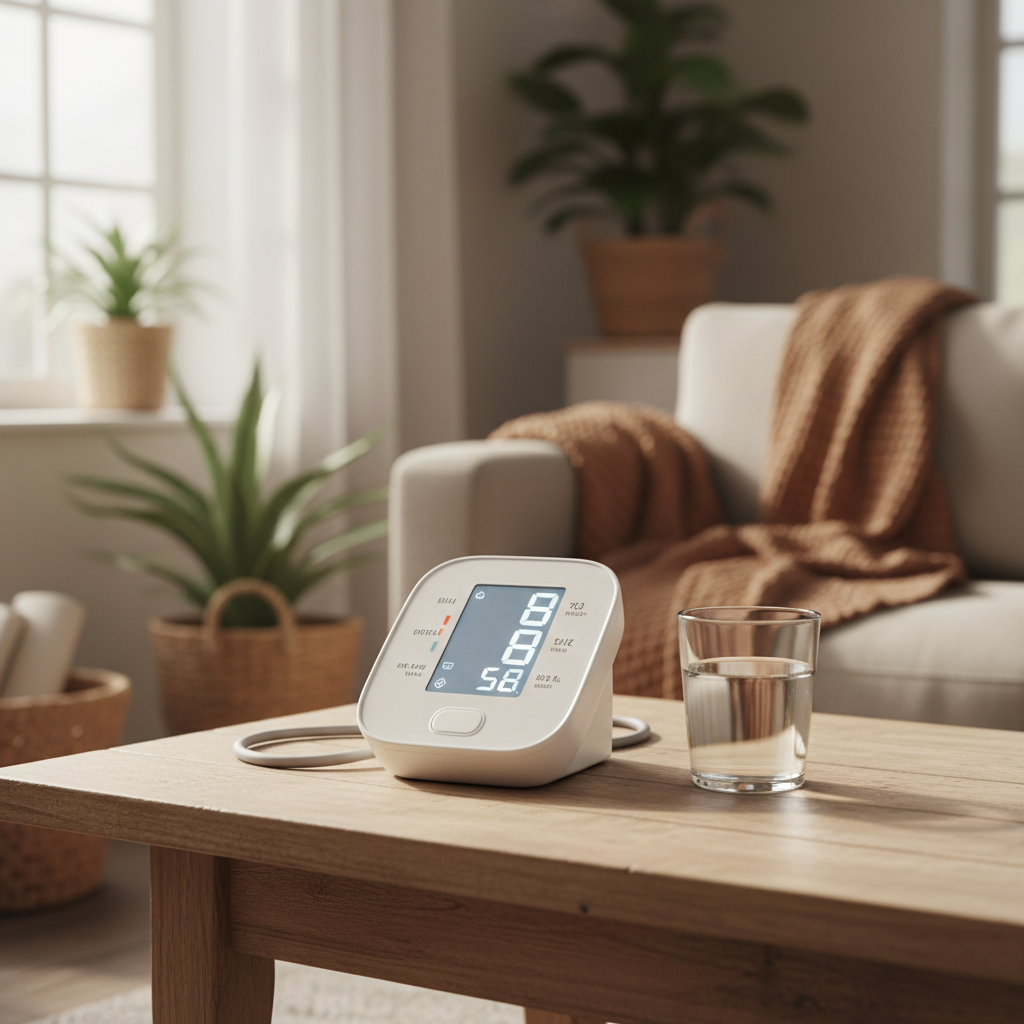
Display readability. Numbers should be large and high-contrast. Backlit screens help in low-light rooms. Color-coded indicators (green/yellow/red) for reading ranges are a genuine help, not just a gimmick.
Cuff fit. An ill-fitting cuff is the single biggest cause of inaccurate readings at home. Most standard cuffs fit arms 9–17 inches in circumference. If your arm is larger, you need an explicitly labeled large or XL cuff — and several of our picks include one in the box.
Our Top Picks
Best Overall: Omron Platinum BP5450
The Omron Platinum BP5450 has earned its place at the top of nearly every serious comparison for good reason. It’s validated by the AHA, cleared by the FDA, and has been tested in clinical settings with older adult populations specifically.
The single wraparound cuff is easy to position correctly even with arthritic hands. One press starts the reading. The large LCD display shows systolic, diastolic, and pulse all at once in numbers big enough to read comfortably from arm’s length. A flashing icon alerts you if an irregular heartbeat is detected during the reading — not a diagnosis, but a useful flag to mention to your doctor.
Memory holds 200 readings split between two users, so spouses can share the device. Bluetooth connectivity links to the Omron Connect app if you want to track trends over time, but the monitor works perfectly without ever touching the app.
Best for: Most seniors who want reliable, validated readings and simple operation.
Best for Large Arms: A&D Medical UA-789AC
A&D Medical is less of a household name than Omron, but the company has been making medical-grade blood pressure equipment for hospitals and clinics for decades. The UA-789AC includes an extra-large cuff as standard — fitting arms up to 21.6 inches — which eliminates the need to source a separately purchased cuff.
Readings are consistently accurate, the device is AHA-validated, and the display is large and clearly organized. It lacks Bluetooth, which keeps the operation simple. One press, one reading. Results are stored for up to 60 readings.
Best for: Seniors with larger arms who’ve struggled to get consistent readings from standard-cuff monitors.
Best With App Connectivity: Withings BPM Connect
If you or a caregiver wants to track readings over time without writing numbers in a notebook, the Withings BPM Connect makes that genuinely easy. It automatically syncs every reading to the Withings Health Mate app via Wi-Fi — no Bluetooth pairing required each time, no cables.
The app generates trend charts and can share data directly with a physician through compatible health platforms. The monitor itself is compact, quiet during inflation, and FDA-cleared. The cuff fits standard adult arm sizes.
One honest caveat: the app is more involved than some seniors want. If your parent or loved one isn’t interested in smartphones, the Omron Platinum above is a better fit.
Best for: Seniors or adult children who want passive tracking and easy sharing with a doctor.
Best Budget Option: Omron Silver BP5250
The Omron Silver BP5250 does most of what the Platinum does at a lower price. It’s AHA-validated, stores 80 readings for a single user, features irregular heartbeat detection, and has the same large, easy-to-read display. It lacks dual-user memory and Bluetooth, which keeps the experience completely simple.
If you just want an accurate, fuss-free monitor and don’t need app connectivity or two-user storage, the Silver is a smart, money-saving choice.
Best for: Seniors on a budget who want proven accuracy without extra features.
How to Take an Accurate Reading at Home
Even the best monitor gives bad numbers if used incorrectly. A few habits make a real difference:
- Sit quietly for five minutes before measuring. Avoid coffee and exercise for 30 minutes prior.
- Keep your feet flat on the floor, back supported, and arm resting at heart height.
- Take two or three readings one minute apart and record the average.
- Measure at the same time each day — morning before medication is a common recommendation, but ask your doctor what works for your situation.
- Don’t talk during the reading.
When to Call Your Doctor
Home monitoring is meant to supplement your care, not replace it. A one-time high reading after a stressful day is usually not cause for alarm. But if your readings are consistently above 130/80 on multiple days, or you ever see numbers above 180/110, contact your doctor promptly. Most monitors include a range guide; color-coded devices make this easier to interpret at a glance.
Frequently Asked Questions
Are wrist blood pressure monitors accurate enough for seniors? Most cardiologists and the AHA recommend upper-arm monitors for home use, especially for older adults. Wrist monitors are convenient but more prone to inaccurate readings if the wrist isn’t held at exactly the right height and angle. Upper-arm models are more forgiving and more consistently accurate.
How often should seniors check their blood pressure at home? There’s no single universal answer — it depends on your situation and your doctor’s guidance. A common approach for people managing hypertension is once in the morning and once in the evening for one to two weeks, then discussing the log with your physician. If your blood pressure is well-controlled and stable, your doctor may suggest less frequent monitoring.
Does insurance cover home blood pressure monitors? Medicare Part B may cover a blood pressure monitor if your doctor documents medical necessity. Coverage varies, so contact your plan directly or ask your doctor’s office to check on your behalf before purchasing.